
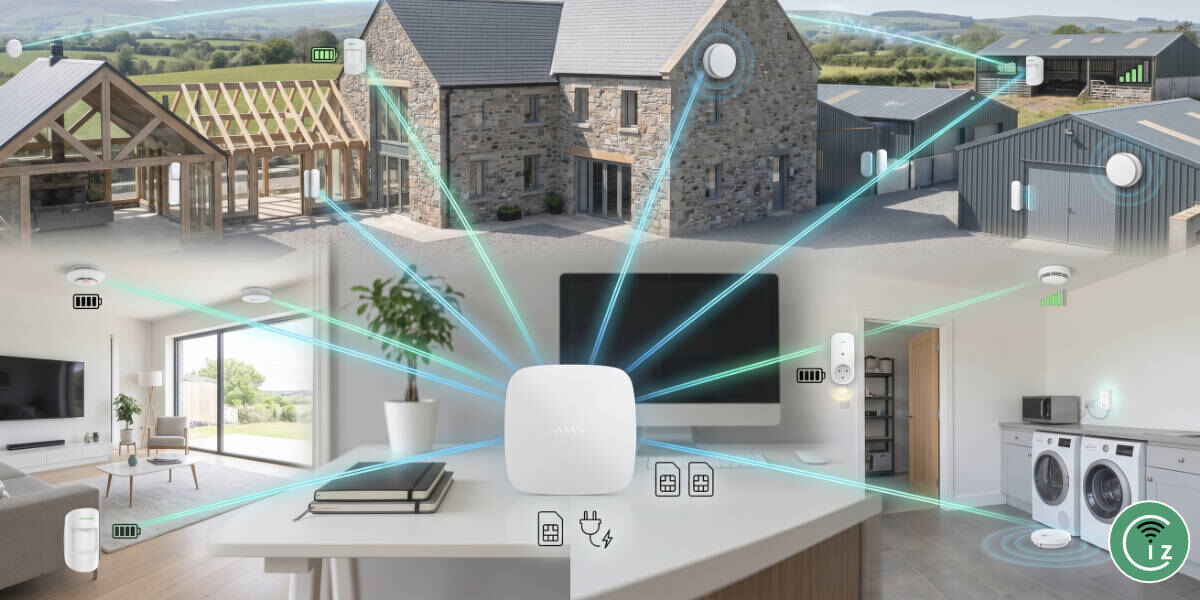
For years, the gold standard in property security meant one thing: wires. If you wanted a system you could trust, you had to accept the disruption of invasive cabling, drilling through walls, and lifting floorboards. Meanwhile, early wireless DIY systems earned a reputation for dropped WiFi, constant battery changes, and signal failures.
But security technology has evolved. Today, modern, wireless, professional-grade systems have come a long way.
At the forefront of this revolution is Ajax. Here is why wireless is now the future of intrusion protection for security-conscious homeowners, modern property managers, and businesses alike.
The Structural Shift: Why Wireless is Replacing Wired Security
The most obvious benefit of a wireless system is the installation. There is no structural renovation required, no chased walls, and no unsightly plastic trunking running along your skirting boards.
But the true advantage is adaptive security. A hardwired sensor is fixed in place; if you remodel your office, build an extension, or simply change the layout of your home, moving a wired sensor is a major headache. Wireless sensors, on the other hand, can be more easily moved and reconfigured as your property layout or risk profile changes. Your security adapts to your life, not the other way around.
Addressing the "Wireless Weakness" Myth
We often hear the same two worries when we talk about wireless: "Will the batteries die while I’m on holiday?" and "What if the signal drops?"
These were valid concerns ten years ago, but professional-grade equipment (what we call Grade 2) is a different beast entirely. It’s engineered to handle those exact problems and meets the strict European standards required for insurance in Ireland.
1. Batteries that actually last - Forget the hassle of climbing a ladder every few months. Modern wireless sensors are incredibly efficient. The latest Ajax range is designed to run for five to seven years on the batteries they come with. The system monitors itself, too. If a battery is finally starting to run low, you’ll get a polite notification on your phone months before it actually needs a swap.
2. It stays connected, even when the power goes - What happens if there’s a power cut or your home broadband goes down?
Standard DIY kits usually just go "blind" the second the WiFi drops. A professional system is much smarter. It uses multiple "lanes" to talk to the outside world. It connects to your WiFi, yes, but it also has a backup battery that lasts up to 16 hours, and it uses cellular SIM cards. If the power goes or the internet cuts out, the system instantly switches to the mobile data network. It’s an "always-on" setup that doesn't care if the local cabinet has a fault or the electricity is flickering.
The Ajax Advantage: Engineering a Superior Perimeter
Not all wireless technology is created equal. Many smart home gadgets rely on standard Z-Wave or Zigbee protocols, which can struggle to penetrate thick walls or cover large areas.
Ajax bypasses this entirely with its proprietary Jeweller radio technology. This military-grade, encrypted protocol allows devices to communicate flawlessly with the central hub at distances of up to 2,000 meters in open space. This incredible range, combined with built-in tamper resistance, means you can secure large commercial properties, sprawling yards, and detached outbuildings effortlessly from a single central hub.
More Than Just a Siren
A modern alarm does a lot more than just make a loud noise when a door opens. It’s more like the "brain" of your property. You can add sensors for things you might not have considered:
- Fire & Smoke: Integrated detectors that alert your phone instantly, even if you aren't home.
- Flood Sensors: Tucked under the dishwasher or near the boiler, these can alert you to a leak before it ruins your floors.
- Smart Automation: You can set a "scenario" to send a notification to your phone if the alarm is not set and you are within a certain distance away from the house.
Frequently Asked Questions
Can wireless alarms be jammed by burglars? Standard DIY systems can be vulnerable to signal blocking. However, an Ajax system features advanced signal jamming detection. If it detects interference on its radio frequencies, it instantly alerts you and the monitoring station, and automatically switches to a clear frequency to keep communicating.
Do wireless alarms work if the internet goes out? Yes. An Ajax Hub has an internal battery backup that lasts up to 16 hours during a power cut. It also houses cellular SIM cards, so if your home WiFi or broadband drops, it instantly switches to the mobile data network to ensure continuous protection.
How often do I need to change the batteries in an Ajax system? Because of its highly energy-efficient Jeweller technology, the batteries in Ajax Baseline detectors boast a lifespan of 5 to 7 years under normal usage. The app will also give you plenty of warning months before a battery actually needs replacing.
Ready to upgrade your security?
Choosing the right system is only half the battle; how it is installed matters just as much. Read our guide on DIY Security to find out why trusting a PSA-registered expert is the safest choice you can make.
Contact Us
We've a variety of ways for you to contact us. Click on the button below to view the options
Contact Us