
Introduction
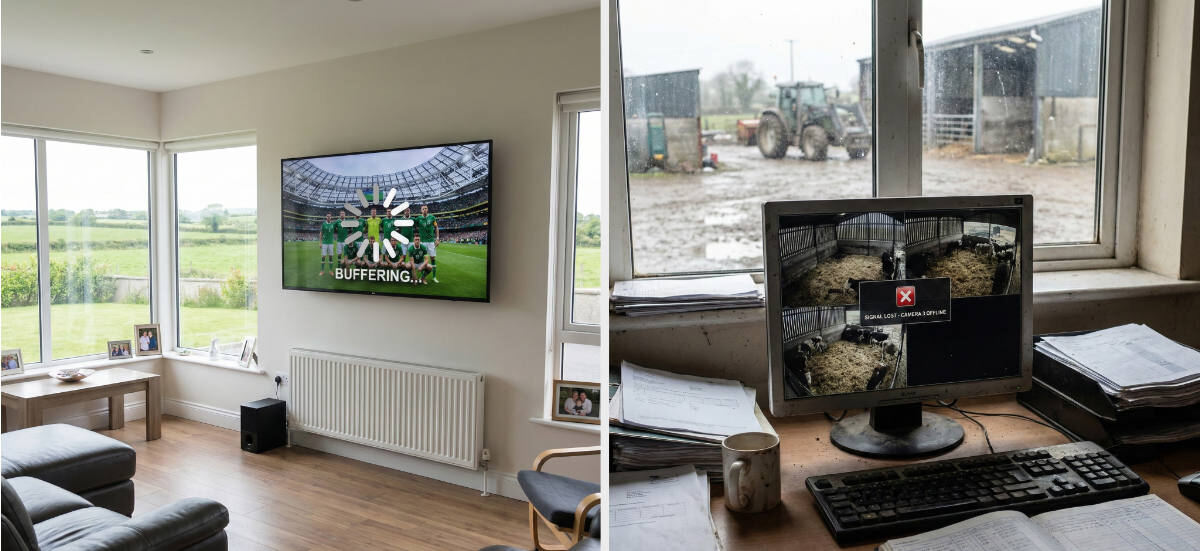
You’ve upgraded to the fastest fibre package available. The salesperson promised lightning speeds, and you’re paying for premium broadband. So why is the football still buffering in the kitchen? And why does the video call drop every time you walk into the hallway?
It’s one of the most common frustrations we hear. The reality is that having "fast internet" coming into your house doesn’t guarantee you’ll have "good WiFi" in every room.
There’s a big difference between the speed of the connection entering your building and the quality of the wireless signal that travels around it. If you’re struggling with dead zones and lagging devices, the problem likely isn’t your internet connection. It’s the obstacles standing in its way.
The "Black Box" Problem
When you sign up with an Internet Service Provider (ISP), they send you a standard router. This is the black or white box that usually sits in the hallway or behind the TV.
For a small, open-plan apartment, these devices are fine. But for a standard Irish semi-detached house, a bungalow, or a stone-built farmhouse, they’re often not powerful enough. The ISP router is designed to get the internet *into* your home, but it’s rarely powerful enough to push that signal through two floors, concrete blocks, and foil-backed insulation.
Why WiFi Struggles (The Science Bit)
WiFi isn’t magic. It’s a radio wave. Just like a car radio loses signal in a tunnel, your WiFi signal gets weaker every time it has to pass through an obstacle.
It comes down to construction materials. In Ireland, we have a mix of old and new, and unfortunately, both are tough on radio waves.
- Stone Walls: Many older homes and farmhouses have thick stone walls. To a WiFi signal, these are essentially impenetrable barriers.
- Foil-Backed Insulation: In modern builds and retrofits, we use high-quality insulation with foil backing. This keeps the heat in, but it acts like a mirror to WiFi, bouncing the signal back rather than letting it pass through to the next room.
- Steel Supports: In schools and offices, steel beams and large floor plans mean the signal simply cannot travel the distance from one end of the building to the other.
The Real World Impact
When your WiFi coverage is patchy, it’s not just about Netflix buffering. It affects the critical technology that keeps your home or business running.
- Security: We often see high-end CCTV systems that fail to record because the camera on the corner of the house can’t maintain a steady link to the router.
- Safety: Smart intruder alarms and door access fobs need a constant connection. If the WiFi drops, your security system might go offline without you realising it.
- Productivity: For the business owner or the school principal, a weak signal means the video conference freezes in the meeting room, or a class set of 30 tablets fails to connect during a lesson.
- Farming: For our rural customers, it might mean you can’t check the calving cameras on your phone from the main house because the signal cannot punch through the external walls.
How to Solve the Problem
So, if the router in the hall isn’t doing the job, what’s the fix?
Many people try to solve this by buying cheap "boosters" or "extenders" that plug into a socket. While these are inexpensive, they often just repeat an already weak signal. It’s a bit like trying to shout a message to someone far away by having someone else shout it halfway. The message still arrives, but it’s distorted and slower.
The permanent solution is to improve the infrastructure.
Instead of relying on one box to cover the whole building, the most effective method is to install dedicated wireless access points. These are additional devices placed in strategic locations, like the attic conversion, the office, or the kitchen. Ideally, these points are hard-wired back to the main router. This creates a "mesh" where your device automatically connects to the strongest signal as you walk around, ensuring you get full speed everywhere.
How We Approach It
Every building is different, so there’s no "one size fits all" box you can just buy off the shelf.
Our approach is to look before we leap. We start by surveying the property to find exactly where the dead zones are and what’s causing them. Once we know the layout, we can discuss the most cost-effective way to get that signal where it needs to go.
Sometimes that means a full enterprise-grade installation for a school, but often it might just mean running a single cable to a better access point in a farmhouse kitchen.
Conclusion
You don’t have to put up with dead zones. If you’re paying for fast broadband, you deserve to use it in every room. By upgrading your internal network, you ensure that your security, heating controls, and smart devices work exactly as they should.
Are you tired of the "spinning wheel" when streaming? Feel free to contact us. We can chat about your setup and see if we can help you get fully connected.
Contact Us
We've a variety of ways for you to contact us. Click on the button below to view the options
Contact Us